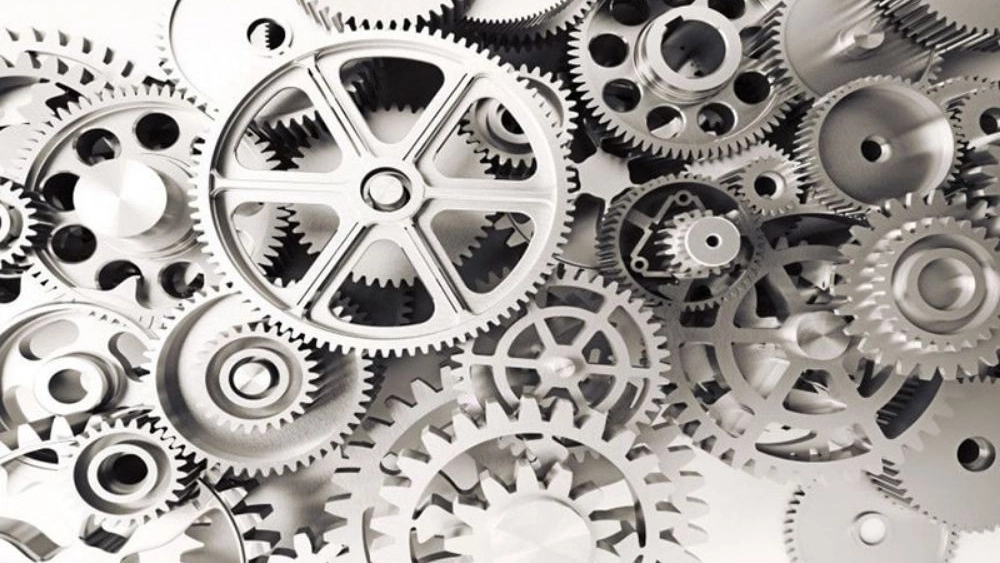
Chain gear in the industry, the wheel, and the chain (chain) each have little functional meaning, and only when the wheel comes with the chains, the meaning and meaning of the function. Therefore, the chain wheel is one of the industrial and toothed equipment with a row and a network of chains around it and transmitted by its teeth; In this way, the chains, along with its structure, can transmit the power generated to the next wheels in the wheel rotation path by placement on the tentacles and teeth.
So in a simpler phrase, any toothed wheel (gear) with the chain mechanism on it can be called the chain wheel. The chain wheel is a common method for transmitting power and changing the torque of the output or speed of a mechanical system and is used when we want to transmit power or motion between the two axes that are constant in place or between two or more rotating shafts.
Application of gears:
Gears are actually small and large parts that cause the transfer of rotational kinetic energy from one part to another. You might say to yourself that this is exactly what belts and chains do. they do well.
Hadestan is completely correct, but the quality of the operation in this equipment has certain differences with belts and chains.
The presence of these parts as a main interface makes Energy transmission is more smooth and the gear material is suitable. It provides the security of modern devices to a large extent.
Construction method
Making these industrial components are done in different ways, the most important of which is through casting, but there are other ways such as clay, staple and cutting, each requireing its own tools and conditions.
The reason for the most common method of making these components is that it can produce high -speed components at high speeds. There is not so much high accuracy.
The types of gears
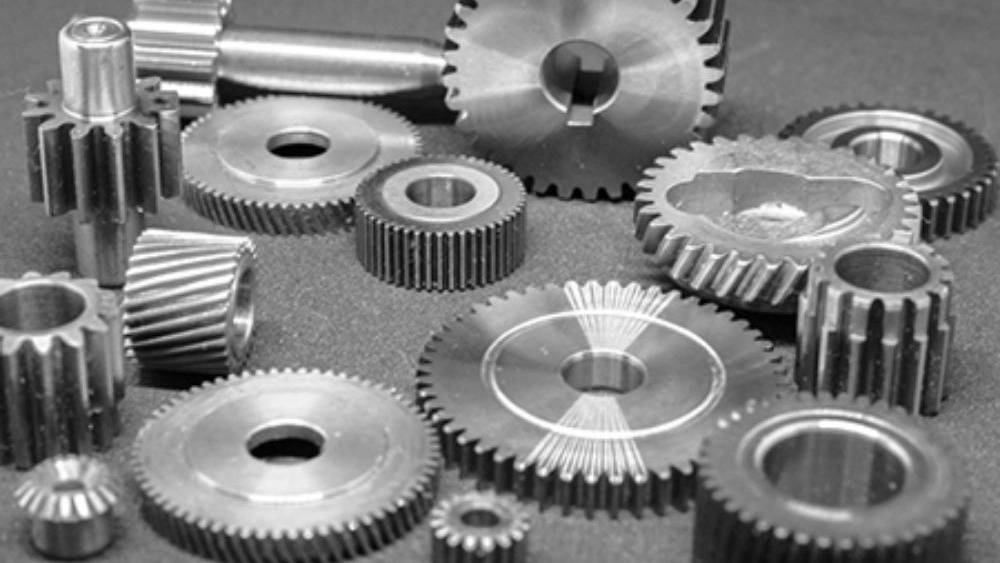
Of a variety of gear wheels, simple
The simple type is one of the most widely used types of cylindrical gears. It has straight teeth and is mounted on parallel axes. In some designs, a large number of these gears are used to reduce power. When two simple gears are used side by side, the smaller gear which has less number of teeth is called pinion. The bigger gear which has more number of teeth is called gear or wheel. One of the characteristics of this type of gear is its high noise. As soon as two teeth engage each other, they hit each other with great force. This impact produces sound and focuses tension on the teeth. The teeth of this gear have wide profiles and only one of the teeth is fully engaged at any moment.
In this type of gear wheels, there is no force in the axis. Simple gear wheel is the most suitable option in applications that need to slow down or multiply the torque. An example of these applications can be referred to as a bullet mill or iron ore crusher.
Of a variety of gears, spirals
One of the use of spiral gear is in parallel axles. The tooth lines in these cylindrical gears are spiral. This type of gear is capable of transmitting more power than the simple type and produces less noise. Lower sound is especially true at medium and high speeds. On the other hand, it is always involved in more than one tooth of each gear.
as a result of the force in each indent to increase the capacity of this type of gear. Due to the spiral shape of the teeth, the gear's engagement begins with point contact and slowly reaches linear contact. As a result, the transfer of power will be even more uniform, and vibrations and abrasion will occur less. The following figure shows a spiral gear sample.
The features that we have listed so far for the spiral gear also cause problems. The angularity of the teeth causes the contact area to slide. As a result of this sliding, axial driving force and heat are created and the efficiency decreases. In order to reduce the effect of axial force, bearings should be used. One of the ways to prevent this driving force is to use a double spiral gear (herringbone gear), which is also known as a spur gear in the industry.
In this model, two spiral gears with opposite directions, They are placed together to neutralize the driving force created along the axis. In applications for which a simple gear is suitable, but the axes are not parallel to each other, choosing this spiral gear is a priority.
Of a variety of gear wheels, cone
These gears have a cone -like appearance and are suitable for cross -axis. Conical gear wheels are most commonly used in places where the angle between the two cross -axis is 2 degrees, but is also used in other angles. The teeth of this gear can be straight, spiral, or hypoidian. Its direct type has the same simple gear problems and the teeth are involved at once.
As a result, the focus of stress on the teeth increases. The direct and spiral type is used when the two axes are perpendicular to one page. Hypoid type is used if the two axes are separate in two separate pages. Note that in this case, the two axes will have no intersection and this creates an exception to define this type of gear.
One of the applications of the bevel gear is as one of the types of gears in the differential of many cars. In the car differential, the ring gear and the input pinion gear are both hypoid type. This design allows the input pinion to be installed lower than the axis of the ring gear. As you can see, the drive shaft is also connected to the input pinion. In this way, the drive shaft does not enter the car compartment. As a result, more space has been allocated to the room.
Of a variety of gear wheels, coils
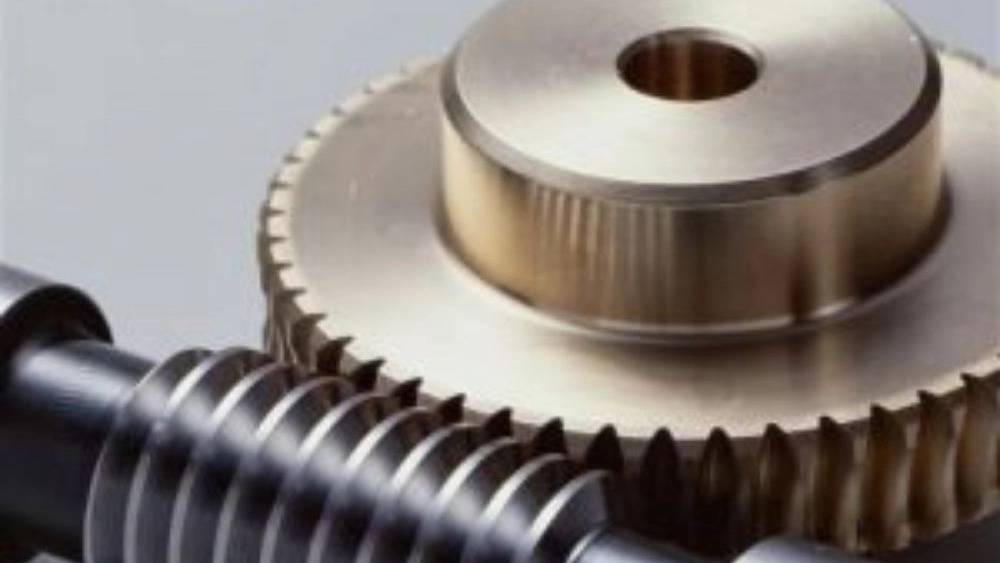
When the gear needs to be reduced, cochlear gears are used. The coil gear is used for reduction ratios of 20: 1 to 300: 1. These gear wheels also increase the torque as a result of slowing down. It should be noted that installing this system and its oil is done properly. In this case, the coil gear will be one of the most softest and lowest types of gear wheels. This set uses a snail (upper axle) and snails (low gear).
The important feature of these parts is that power transmission is done only from the snail to the snail wheel. Usually, most of the designs are done in such a way that the auger wheel is not able to turn the auger. This feature is known as self-braking feature. The smaller the advance angle in the snail, the greater this property. On the other hand, the larger the advance angle, the lower the self-braking property. The figure below shows this angle in the snail. The self-locking feature can be used to prevent reverse movement. For example, in the conveyor belt system, these gears are used for braking or emergency stop.
Shoulder
The shoulder gear, which is another type of gear, is used to convert circular motion into linear motion or vice versa. Usually, these gears are used together with a simple gear (pinion). For this reason, the whole set is called Rack & Pinion. The teeth on the gear can be straight or spiral. One of the applications of this type of gears is in hand scales.